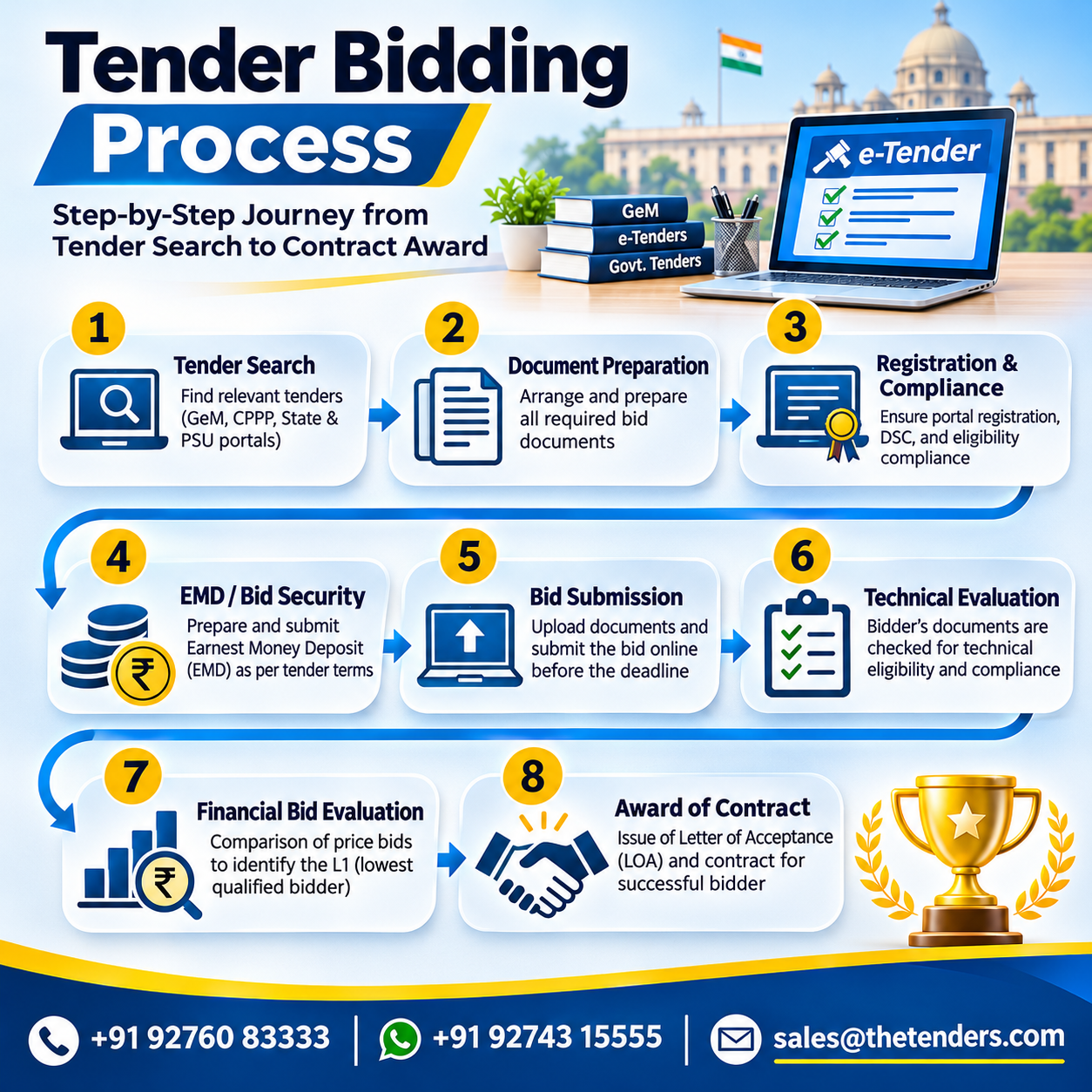
The government tender bidding process is a formal procedure through which government departments invite businesses to submit their proposals and price quotations for specific products, services or projects.
Businesses interested in participating must follow the instructions and eligibility conditions mentioned in the tender document.
Government tenders are published on different procurement platforms, including:
Central Public Procurement Portal (CPPP)
Government e-Marketplace (GeM)
Gujarat nProcure Portal
State Government E-Procurement Portals
Various PSU and Departmental Websites
What Are the Steps in the Government Tender Bidding Process?
The following are the major steps involved in participating in government tenders.
1. Search for Suitable Government Tenders
The first step is finding relevant tender opportunities according to your business activities, products, services and geographical preferences.
Businesses can search for tenders through government procurement portals and tender information platforms.
For example, manufacturers can search for product supply tenders, contractors can identify civil construction opportunities, and service providers can find manpower, maintenance and consultancy tenders.
Important things to check:
Tender reference number
Department and organization name
Product or service requirements
Tender submission deadline
Estimated tender value
Location of work or supply
2. Download and Understand Tender Documents
After identifying a suitable tender, download the complete tender document and carefully review its conditions.
Tender documents generally contain the Notice Inviting Tender (NIT), technical specifications, eligibility criteria, commercial conditions and submission instructions.
Pay special attention to:
Eligibility requirements
Minimum turnover criteria
Previous work experience
EMD and tender fees
Technical specifications
Required certificates
Bid submission deadline
Understanding these conditions helps businesses determine whether they are eligible to participate.
3. Check Eligibility Criteria
Before preparing a bid, verify whether your company meets all the eligibility requirements.
Common eligibility conditions include:
Company registration
GST registration
PAN card
Minimum annual turnover
Previous work experience
Relevant product certifications
Manufacturer authorization, where required
MSME registration, where applicable
Some tenders may provide exemptions or relaxations for eligible MSMEs and other categories. These depend on the applicable procurement policy and specific tender conditions.
4. Arrange the Required Tender Documents
Documentation is one of the most important parts of the government tender bidding process.
Businesses generally need to arrange the following documents:
Document | Purpose |
|---|---|
PAN Card | Business identification |
GST Certificate | Tax registration |
Company Registration | Legal business details |
MSME / Udyam | MSME identification |
Bank Details | Financial information |
Financial Statements | Turnover verification |
Experience Certificates | Previous work details |
Digital Signature Certificate | Online bid signing |
Product Specifications | Technical compliance |
Additional documents may be required depending on the department and tender conditions.
5. Prepare the Technical Bid
The technical bid contains information about the bidder's business, eligibility, experience, products and compliance with the tender specifications.
The bidder must provide all the documents requested by the department.
For product supply tenders, technical documents may include product specifications, catalogues, certifications, manufacturer details and authorization letters.
For service and construction tenders, work experience, manpower details, technical proposals and project-related documents may be required.
Proper technical bid preparation helps ensure that the submitted proposal addresses the tender requirements.
6. Prepare the Financial Bid
The financial bid contains the price quotation submitted by the bidder.
Depending on the tender format, bidders may need to fill in a BOQ (Bill of Quantities) or another prescribed price schedule.
Financial bid preparation may involve:
Product or service rates
GST and applicable taxes
Transportation charges
Installation charges
Labour costs
Other commercial expenses
Always follow the prescribed financial bid format. Do not modify protected BOQ templates or enter pricing information in the technical bid where prohibited.
7. Submit the Tender Online
Most government departments accept tender applications through online e-procurement portals.
The general online tender submission procedure includes:
Register on the relevant tender portal.
Log in using your bidder credentials.
Search and select the tender.
Pay tender fees and EMD, if applicable.
Upload technical documents.
Complete the financial bid or BOQ.
Sign the required documents using a valid Digital Signature Certificate (DSC).
Submit the final bid before the deadline.
Save the submission acknowledgement.
Businesses should avoid waiting until the last moment because technical issues, internet connectivity or document-upload problems may delay submission.
8. Technical Evaluation and Financial Evaluation
After the submission deadline, the concerned department starts evaluating the received bids.
The evaluation generally involves two important stages:
Technical Evaluation: The department checks the bidder's eligibility, submitted documents, technical specifications and compliance with tender conditions.
Financial Evaluation: Financial bids of technically qualified bidders are evaluated according to the tender's prescribed commercial and selection criteria.
In many tenders, the lowest evaluated responsive bidder may be selected, but selection depends on the applicable procurement method and tender conditions.
9. Tender Result and Award of Contract
After completing the evaluation process, the department declares the tender result and may issue a Letter of Acceptance (LOA) or work order to the selected bidder.
The successful bidder may need to complete additional formalities, such as performance security submission, agreement signing and other contractual requirements.
Businesses can also monitor tender awarded results to understand market competition and procurement trends.
What Are the Common Reasons for Tender Bid Rejection?
Even small mistakes can lead to bid rejection. Some common reasons include:
Missing mandatory documents.
Incorrect technical specifications.
Incomplete financial bid.
Incorrect BOQ format.
Failure to meet eligibility conditions.
Invalid or expired DSC.
Late bid submission.
Non-compliance with tender terms and conditions.
Careful document verification before final submission can help reduce avoidable errors.
How Can a Tender Bidding Consultant Help?
Managing the complete tender process can be challenging, especially for businesses participating in multiple government tenders.
A professional Tender Bidding Consultant can assist with different stages of tender participation.
Services may include:
Government Tender Search
Tender Document Analysis
Eligibility Verification
Technical Bid Preparation
Financial Bid Preparation
BOQ Assistance
Online Tender Submission
GeM Tender Bidding
Tender Documentation Support
Tender Result Tracking
Professional assistance can help businesses understand tender requirements, organize documentation and manage online bidding procedures.
Why Choose TheTenders.com for Government Tender Bidding Support?
TheTenders.com is a professional tender information and bidding assistance platform helping manufacturers, suppliers, contractors and service providers across India.
We provide support for different government and private tender requirements.
Our Services Include:
Government and Private Tender Information
State-Wise Tender Search
Daily Tender Alerts
Tender Awarded Results
Tender Documentation Assistance
Technical and Financial Bid Preparation
Online E-Tender Submission Assistance
GeM Seller Registration
GeM Tender Bidding Support
OEM Panel Creation
Brand Approval Assistance
GeM Catalogue Management
L1 Comparison Support
Digital Signature Certificate Assistance
Whether you are a new bidder or an experienced contractor, TheTenders.com can help you understand tender requirements and manage your bidding activities.
Conclusion
Understanding the Government Tender Bidding Process is essential for businesses looking to participate in government procurement opportunities in India.
From finding suitable tenders and checking eligibility to preparing technical and financial bids, every stage requires proper attention. Accurate documentation, compliance with tender conditions and timely online submission are important for successful participation.
If you are looking for professional tender search, documentation and bidding assistance, connect with TheTenders.com.
Professional Government Tender Bidding Support
www.thetenders.com
+91 92760 83333
sales@thetenders.com